
For Parents of
Secondary 1–2 Students
Why Some Students Improve 2–3 Grades Within 6 Months
And Others Stay Stuck Doing More Practice
If drilling more worksheets and hopping from centre hasn't worked, maybe the problem isn't your teen.
It's the method.

"After struggling to pass Math even with other tuition centres,
my son scored a distinction in Math after switching to Edumath."
-Ms Seetoh
You've Already Spent Thousands on Tuition.
So Why Is Your Teen Still Getting C5-C6 in Mathematics?
If hopping from centre to centre and drilling more worksheets hasn't worked, maybe the problem isn't your teen.
It's the method.
"After struggling to pass Math even with other tuition centres,
my son scored a distinction in Math after switching to Edumath."
-Ms Seetoh
After All The Drilling, Past Year Papers, Late Nights, and Tuition...
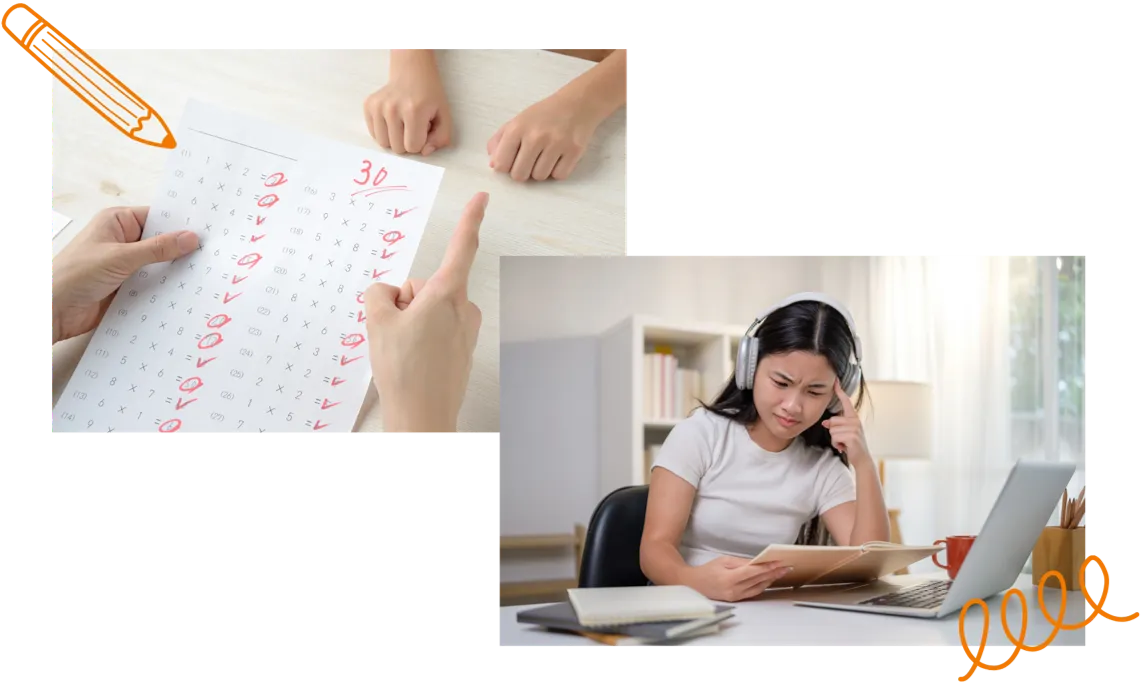
You've sent your teen to multiple tuition centres.
You've bought all the assessment books from Popular.
You've even asked the tutor to give more homework.
And yet, the grades aren't moving.
Your teen's E-Math is still hovering around C5-C6.
He’s still getting Cs on every WAs and EOY, still making the same careless mistakes,
and still forgetting what they learned just last week.
You watch them spend hours at their desk every night,
but when the results come back, it's the same disappointing score.
Sometimes it's even worse than before.
And you wonder...
Is your teen not able to keep up?
Is he just lazy?
What is he doing spending hours at the desk but not showing the results?

Let me tell you something that might surprise you.
Your teen isn't lazy.
They're not careless.
And they're definitely not "bad at Mathematics."
After 10 years as a Maths tutor, I’ll tell you this.
Your child CANNOT get better by doing endless past year papers.
If your teen doesn't understand why Chapter 1 (basic algebra)
is the foundation for Chapter 5 (quadratic equations),
doing 50 more pages of worksheets won't help them.
They'll just keep making the same mistakes over and over again.
The sad part is when the teenagers themselves begin to believe
that they're not smart enough, that Mathematics "just isn't for them."

Because in Edumath, every child can excel at Mathematics.
What If It Doesn't Have to Be This Way?
What if there's a way to pinpoint exactly where your teen is struggling and fix it at the root, so they stop repeating the same errors and actually start understanding the logic behind each question?

Introducing Edumath's Proprietary Diagnostic Test.
Get an exclusive diagnostic session that has helped us guide over 80% of our students to scoring As or improving their grades by 1-3 jumps within 6 months.

Every child that comes our way sits for a diagnostic test that is exclusive to our centre.
This diagnostic test helps to diagnose your child's strengths and weaknesses in Maths, including:
Exactly how far behind (or ahead) they are compared to MOE syllabus benchmarks - so you know if they're on track for their target grade.
The exact topics where your child is losing the most marks - so you know precisely what to fix first (not just "practice more")
Their "exam panic triggers" - the specific question types that make them freeze or go blank under pressure - things they won't really share with parents (you'll be surprised)
The #1 study habit that's sabotaging their retention - why they forget what they learned last week (and how to fix it)
Hidden strengths they don't even know they have - skills that can be leveraged to unlock faster improvement in weak areas
Whether their mistakes are careless errors or conceptual gaps - the difference between needing 2 weeks vs 6 months to improve
Live C.A.R.E. Method Demo - Watch us fix one of your child's mistakes on the spot
15-Minute Results Consultation - Coach Joshua explains the findings and answers your questions
and more!

This diagnostic test is exclusive to Edumath -
you won't find it at any other tuition centre in Singapore.
It's the secret behind why over 80% of our students score As or jump 1-3 grades within 6 months.
This deep dive diagnostic will require 90 minutes with us, and is appointment-based only.
Due to high demand, we can only take a limited number of diagnostic sessions each month.
Appointments are filling up fast, and we don't accept walk-ins for this test.
Book Your Exclusive Test Now For Only $20 - First Come, First Served.
C.A.R.E
Framework
C - Correct the Logic
Most students treat Maths like a guessing game. They move numbers around based on what "feels right" instead of following fundamental laws.
We fix the broken "Algebra Grammar" in their head so they stop guessing and start knowing exactly why a number moves from one side of the equation to the other.
Here's an example: Your teen keeps getting sign errors for cross-multiplication. That's not carelessness - that's a logic gap.
We teach them the "Double Pair Bearing" method so they never cross-multiply blindly again.
A - Articulate the Steps
Your teen isn't careless. They're just overwhelmed.
They're trying to hold all the numbers, signs, and operations in their head at once. When their brain gets full, they drop a negative sign or skip a step.
We force them to offload mental work onto paper through mandatory visual habits like arrows, brackets, and labels, catching errors before they happen.
Here's how it works: We don't allow students to write the answer until they've drawn the visual cue that justifies it.
This trains them to slow down and show their working properly instead of rushing through.
R - Recognise the Method
Your teen blanks out during exams because they treat every question like a brand-new mystery they've never seen before.
We train them to spot hidden "triggers" - visual cues that tell them exactly which formula to use and when to use it.
For example, instead of panicking when they see 3x² - 27 = 0, they learn to scan for the triggers, which instantly points them to factorise then solve for x.
No more guessing which formula to use for different Math questions. No more panic.
E - Expose Blindspots
Most students make a mistake, glance at the answer key, nod their head, and move on. They fix the answer on the paper, but not the misconception in their brain.
We use the "Red Flag Method" to tag specific weak spots so your teen never makes the same mistake twice.
Here's what that looks like: When a mistake happens, your teen must annotate exactly why it happened - "I used the wrong formula" versus "I copied the number wrong."
This turns every error into a data point for improvement instead of just another careless mistake.
R - Recognise the Method
Your child blanks out during exams because they treat every question like a brand-new mystery they've never seen before.
We train them to spot hidden "triggers" - visual cues that tell them exactly which formula to use and when to use it.
For example, instead of panicking when they see 3x² - 27 = 0, they learn to scan for the triggers, which instantly points them to factorise then solve for x.
No more guessing which formula to use for different Math questions. No more panic.
E - Expose Blindspots
Most students make a mistake, glance at the answer key, nod their head, and move on. They fix the answer on the paper, but not the misconception in their brain.
We use the "Red Flag Method" to tag specific weak spots so your child never makes the same mistake twice.
Here's what that looks like: When a mistake happens, your child must annotate exactly why it happened - "I used the wrong formula" versus "I copied the number wrong."
This turns every error into a data point for improvement instead of just another careless mistake.
“My son went from struggling and defeated to ranking Top 3 in his class
and Edumath gave him his confidence back.”
- Ms Wong
Why Edumath?
Meet The Specialists Behind The Transformation

For the past 10 years, we have perfected a single teaching philosophy:
Tackle the root cause, not the symptom.
We don't look at surface-level errors. We target the actual foundational gaps and poor study habits that keep students stuck at the same grade year after year.
Instead of just drilling more papers, our team operates like diagnostic specialists.
Whether it's Coach Joshua or one of our Senior Tutors, we dig deep to fix the logic gaps that school teachers often miss, ensuring your teen actually understands the why behind the Math.
Here's what makes our approach different from other tuition centres:

We don't guess. We diagnose.
Before prescribing "more practice," we run a deep-dive diagnostic on your teen's actual WA/EOY papers to uncover the root issue.
Is it a logic gap? Retention failure? Missing pattern recognition? We find out first.
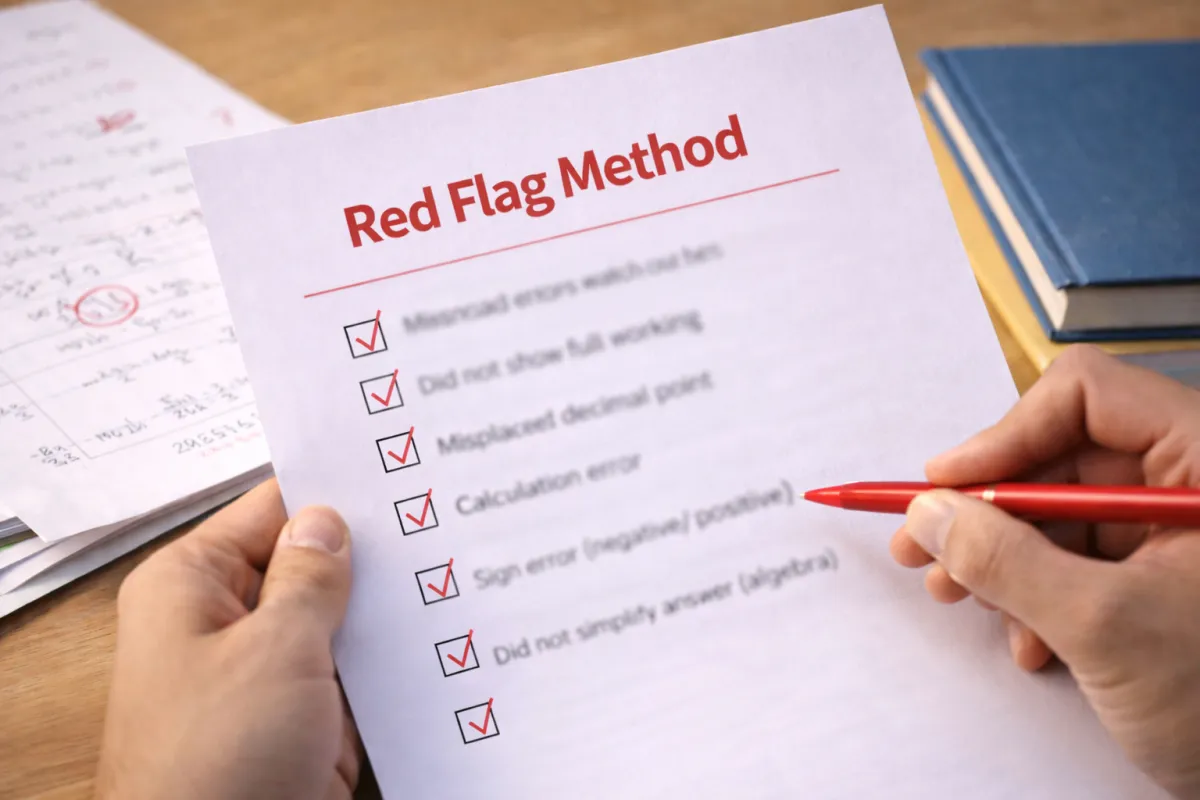
We don't just mark answers.
We tag blindspots.
Using our Red Flag Method, we help your teen spot and correct specific errors they keep repeating, so they don't make the same mistake twice.

We don't throw more content at them.
We teach recognition.
Through the C.A.R.E. Framework, your teen learns to recognise question types quickly, apply the right method, and reduce that exam panic that makes them go blank.

We believe in clarity over volume.
We rebuild their Algebra foundation, train visual step-by-step clarity, and coach them to make smarter Maths decisions even when they're under exam pressure.

We don't build robots.
We build thinkers.
It's not about how many hours you study or
how many past year papers you do. It's about how clearly you see the concept and understand the logic behind it.
And when students finally "see" this, that's when the grades jump.
We Have Taught Students From




Real Results from Real Parents / Students
Don't Just Take Our Word for It. Here's What Parents and Students Say:
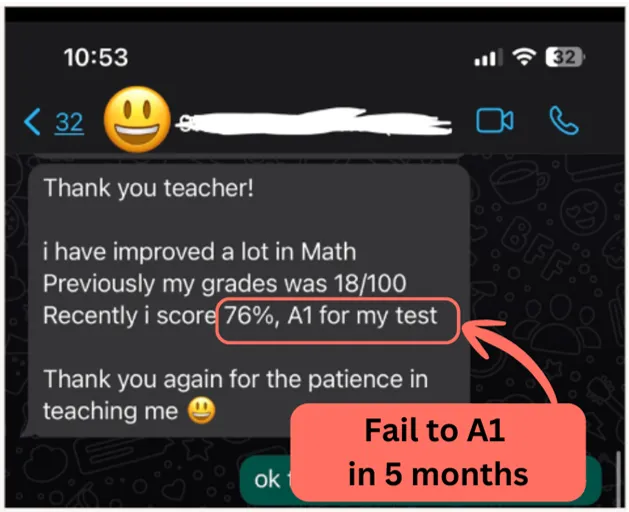
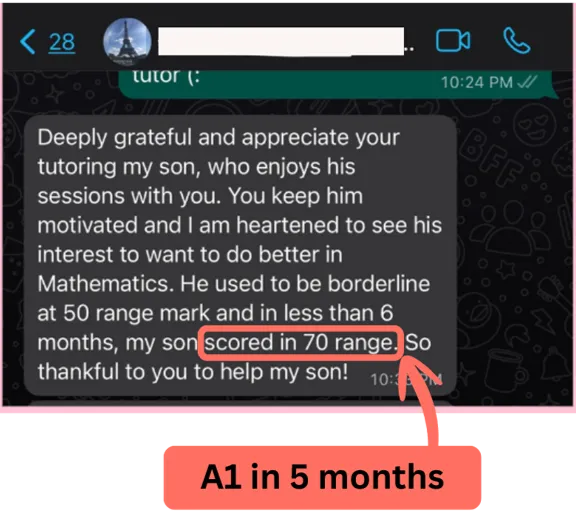
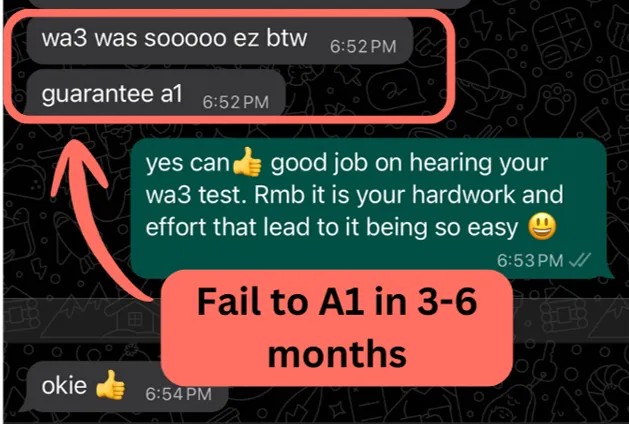
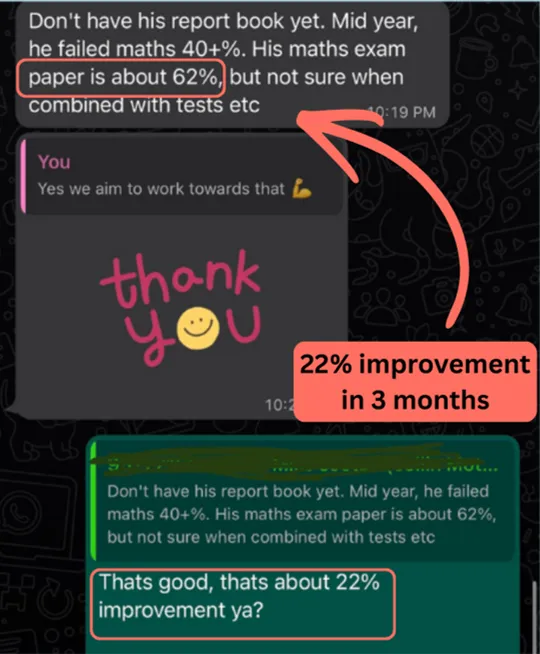
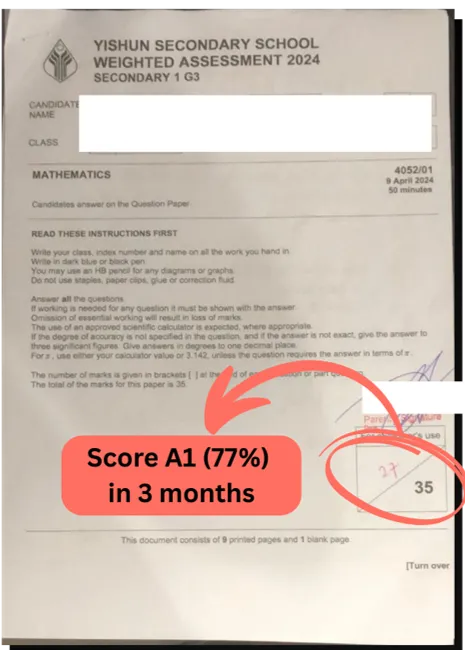
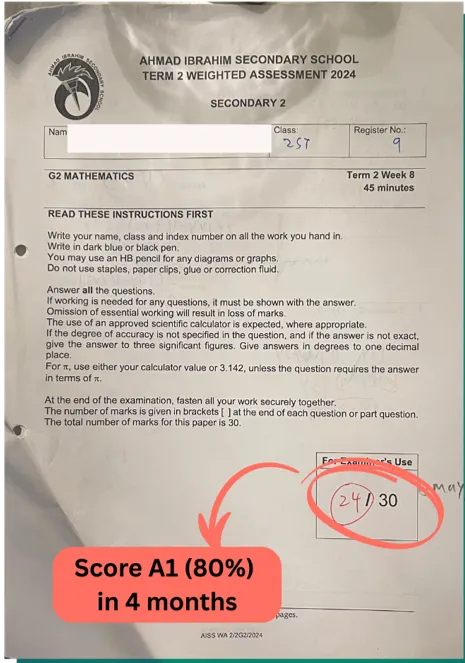
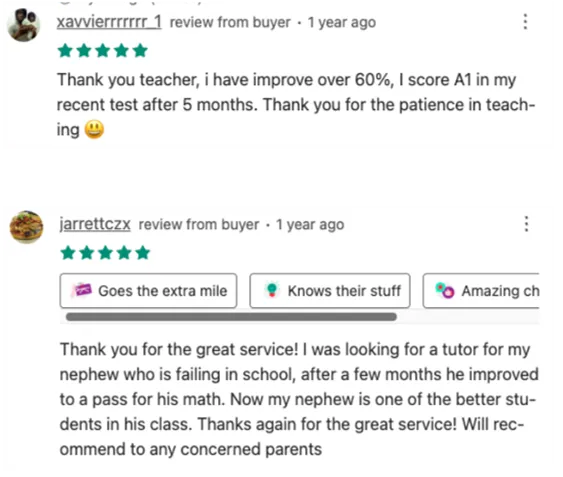
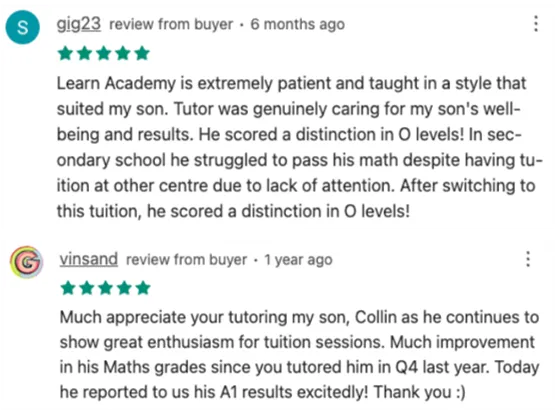

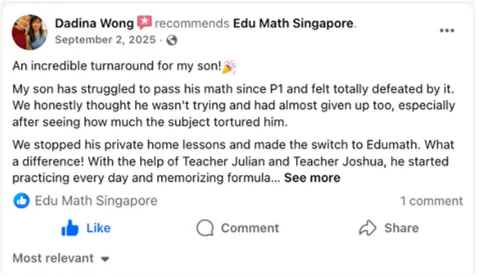
Over 80% of our students score A or achieve 1-3 grade improvements after 6 months of tuition.
Here's How to Get Started:

Click the button below to book your 1.5-hour diagnostic session.
To ensure your teen receives a personalised experience, a $20 diagnostic fee is used to assess their current Math level and tailor the session specifically to their needs.

Bring your teen's WA/EOY papers to the session so we can analyse their actual exam papers and pinpoint exactly where they're losing marks.

Attend the session where we'll show you and your teen the C.A.R.E. Framework in action, demonstrate how to fix their specific mistakes on the spot, and give you a detailed diagnostic report.
What You'll Get in This
1.5-Hour Diagnostic Session:
A deep-dive analysis of your teen's WA/EOY papers: We'll identify your teen's careless mistakes and show you the patterns you've been missing all along.
A live demo of the C.A.R.E. Framework in action: You'll see how issues can be fixed on the spot, and how your teen can solve previously troubling questions effortlessly after we apply the framework.
A custom diagnostic report: You'll walk away with a tangible map of your teen's specific blindspots. No more vague feedback like "needs to practise more." You'll know exactly which topics are sabotaging their grade.
A clear 6-month improvement plan: Based on the diagnostic, we'll map out a realistic roadmap for your teen. For example, "If we fix their Algebra Grammar and get them to track common errors, they can jump 2-3 grades within 6 months."
This is a strategy session grounded in data, diagnostics, and a decade of results.
Why There’s a $20 Diagnostic Fee
This one-time fee allows us to prepare a proper diagnostic for your teen.
We’ll first send a diagnostic worksheet to your doorstep, review your teen’s responses in advance, and then use that insight to run a focused, personalised diagnostic session.
This ensures you gain clarity on your teen’s current Maths proficiency and a clear plan forward — not a generic trial.
Why You Need to Act Now
Here's the truth that most parents don't realise.

The longer you wait to fix the foundation, the harder it becomes to catch up later.
If your teen is in Sec 1 or Sec 2 now, you're in the best window to
intervene and turn things around.
If you wait until Sec 3 or Sec 4, you're not just fixing knowledge gaps anymore.
You're also fighting demoralisation, exam anxiety, and years of
reinforced bad habits that have become automatic.
Many parents think they can wait until Sec 3 to salvage their teenager’s grades.
But by then, the cost of repair is 10 times higher and the emotional toll on your child is 10 times heavier.
Don't let regret be the reason your teen never reaches their potential in Mathematics.
When your teen receives expert teaching that shows them the right strategies, and proper guidance that identifies their specific gaps, improvement becomes possible and even inevitable.
Let's give your teen a proven method that works instead of just throwing more assessment books at the problem.

The longer you wait to fix the foundation,
the harder it becomes to catch up later.
Here’s What Changes After Joining Edumath
Where Your Teen Is Now:
Studying for hours but still stuck at C or borderline pass
Memorising formulas without knowing when or why to use them
Making the same careless mistakes repeatedly
Panicking when questions look unfamiliar
Guessing methods and hoping for the best
Losing confidence and saying “I’m just not good at Math”
Parents buying more assessment books — with little improvement
Where Your Teen Will Be After Edumaths:
Clear on which method to use the moment they read a question
Understands the logic behind every step, not just the answer
Careless mistakes reduced because blindspots are identified early
Calm and confident during tests — no more panicking.
Able to recognise question types quickly using the C.A.R.E.™ Framework
Grades improving by 1–3 bands within 6 months
Confidence restored — Math no longer feels scary or overwhelming
This isn’t about more homework.
It’s about fixing the foundation the right way — before it’s too late.
“I improved from a borderline pass to
over 80% within six months after joining Edumath.”
-Student Loh
Got Questions?
Let's Clear Things Up!
Is this just another tuition centre with a different name?
No. Edumaths is built around a diagnostic-based system called the C.A.R.E.™ Framework. We analyse your child’s actual WA/EOY papers, identify logic gaps and blindspots, and teach them how to think, not what to memorise.
My teen keeps making careless mistakes. Can this really be fixed?
Yes. Most “careless mistakes” are actually unseen logic or process errors. Using our Red Flag Method, we tag recurring mistakes so your child learns to spot and correct them before they lose marks again.
How fast can we expect to see improvement?
Many students begin to feel clearer and more confident within weeks. On average, over 70% of our students improve 1–3 grades within 6 months, with some going from borderline pass to Top 3 in class or distinction level.
My teen understands during tuition, but forgets everything later. Why?
This usually means the learning is surface-level. Many students can follow along in class but don’t truly internalise the logic behind each step. At Edumaths, we focus on retention and recognition, teaching students how to identify question types and apply the right method independently — so learning sticks long after class ends.
Will this help if my teen is already losing confidence in Math?
Yes. In fact, many of our students join us after they’ve already started believing they’re “just not good at Math.” By fixing the root causes and helping them experience small, consistent wins, confidence naturally rebuilds. When students finally understand why something works, their mindset changes along with their grades.